


Introduction
In today’s world of hardware engineering, it usually takes a lot of time and effort to estimate sheet metal fabrication cost accurately. Quite often, many hardware engineers and purchasing departments experience delays in quotations and unexpected change orders due to design issues found late in the production cycle.
The root cause is the inability to perform design for manufacturability analysis in advance when using traditional manual quotation methods. Without automated DFM checks, design conflicts will be found only during production leading to expensive changes. This paper will provide the information on how OEM engineers can get reliable online manufacturing quote with DFM rule engines through an online platform.
Why Do Hidden Expenses Constantly Inflate Custom Sheet Metal Cost Estimates?
The understanding of the drivers of custom sheet metal cost quotation should include several factors such as material waste due to poor nesting, wrong conversion from punching vs. laser cutting hours, and wrong K-factor settings.
1. The Role of Manufacturing Cost Transparency in Supplier Pricing
Traditional quotation systems do not provide manufacturing cost transparency. It means that suppliers have to put additional risk premiums because they cannot verify design information before quoting.
2. How Surface Treatment Requirements Escalate Costs
The cost of surface treatment is typically underappreciated, especially where requirements for corrosion protection exist. In accordance with the ASTM B117 salt spray test standard, parts that are required to have 500 hours of salt spray test require additional pretreatment and coating, raising per-part finishing expenses and impacting total sheet metal fabrication cost.
Can Advanced Design for Manufacturability (DFM) Eliminate Post-Quote Engineering Changes?
Advanced design for manufacturability analysis plays a key role in rapid prototyping services and low-volume production. Typical design mistakes increase costs without value; advanced design for manufacturability algorithms detect these mistakes in the very beginning.
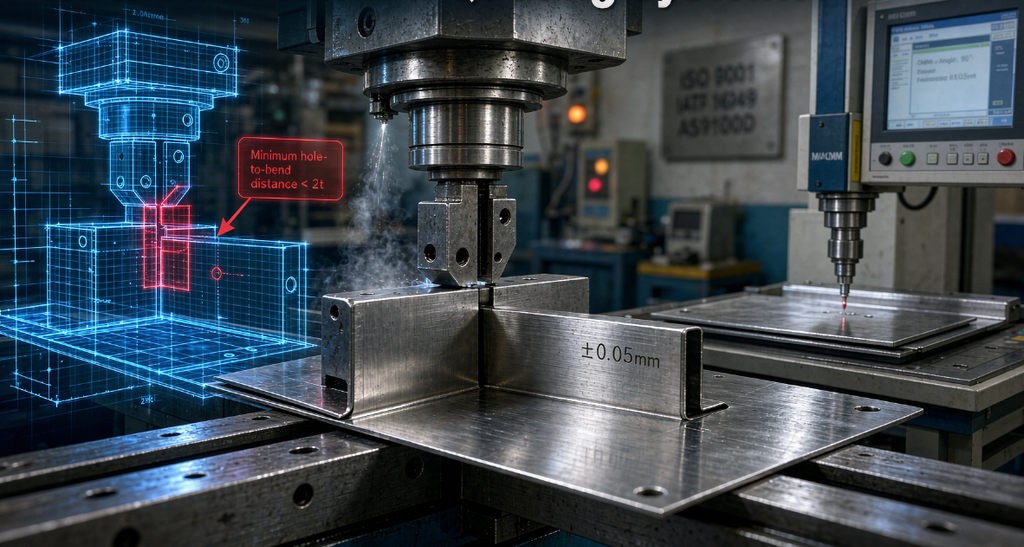
- Identifying Critical Design Flaws Before Production: Blind holes near bend lines can cause tearing problems while performing bending using press brakes. Excessive tolerance on non-critical surfaces makes additional machining necessary. Advanced design for manufacturability algorithms detect bend interference, minimum hole diameter, and minimum flange length in real time.
- The Financial Impact of Early DFM Feedback: By pointing out those factors in quoting, engineers will be able to alter the design before committing to tooling. This avoids expensive ECOs down the road; thus saving on the ; cost of low-volume production and rapid prototyping services.
Data source: Haizol 2026 White Paper on Tiered Pricing for Precision CNC and Sheet Metal Fabrication in China (Cost models for pneumatic fixtures and automated bending).
How Do Automated Algorithms Deliver an Accurate Manufacturing Quote Online in Seconds?
The manual quoting process takes between three and five days, whereas the accurate manufacturing quote online analyzing 3D CAD or 2D drawing designs takes less than 60 seconds.
- How the Sheet Metal Quote Calculator Processes Geometry: The sheet metal quote calculator evaluates geometry, computes material cutting speeds, and develops tool path and process planning in real-time. This helps engineers to know how much it will cost them to manufacture in a matter of minutes.
- Accessing Instant Quotes Through Digital Portal: Engineers require instant quote calculators to have sheet metal parts quotes provided instantly via digital platform portals to avoid budget surprises.
Which Precision Tolerances Really Drive Up Precision Sheet Metal Cost Profiles?
All tolerances do not have similar costs in terms of cost. An exponential increase in the precision sheet metal cost occurs if tolerances exceed standard levels.
1. Understanding Tolerance-Driven Cost Escalation
Tolerances of ±0.05mm require secondary machining, slow machining speed, specialized fixturing, and temperature control. ISO 2768 general tolerancing standard provides the allowable variation for linear and geometrical dimensions. This ensures that the standard is applied in the specification of tolerances wherever needed.
2. The Role of Inspection Technology in Compliance
Due to industrial innovation, there is need to embrace CMM in tolerance verification. During the scaling up from prototypes to the manufacturing stage, selection of the sheet metal fabrication service with the correct tolerances and finishing is important.
Data Sources: Zeiss CMM official calibration report (measurement accuracy of 0.0009 mm & MPEE volumetric length measurement error) and the ISO 2768-mk table of limit deviations.
How Can Digital Quoting Platforms Optimize Overall Supply Chain Efficiency?
Quoting systems on the internet revolutionize procurement. The ability to get fabrication quote online or an online sheet metal quote within minutes cuts the time from weeks.
1. Integrating Inventory and Capacity Data
Such platforms incorporate information about raw material stock, production capacity, and logistics scheduling. Aligning needs with capabilities in real time makes unnecessary repetition of information exchange.
2. Accelerating Time-to-Market Through Automation
This comprehensive process makes the supply chain efficiency by cutting down lead time, costs and material stock problems. Teams modify designs quickly with real time pricing.
What Are the Key Industry Standards for Evaluating a High-Precision Sheet Metal Fabrication Partner?
Choosing the right sheet metal fabrication partner needs an assessment of the quality management system.
The Importance of Certified Quality Systems
ISO 9001, IATF 16949, AS9100D, and ISO 14001 define standards for process control and traceability. Batch productions that meet compliance and regulatory standards in various industries such as aerospace, automotive, and medical are provided through these standards.
Real-World Validation Through Proven Capability
LS Manufacturing is a good example through its 20+ years of experience dealing with 28,000+ clients in 150 countries. This company offers an integrated quotation system that integrates automated DFM, costing model, and certified quality assurance with ±0.1mm accuracy and 99.8% on-time delivery.
Data source: LS Manufacturing 2025–2026 automated DFM 3D/2D drawing analysis logs (Project No. #MED-2025-112, sample size >1,200).
Conclusion
Sheet metal fabrication cost control involves a delicate balance between proper design specification, realistic tolerance allowance, and cost accounting system. With the help of software solutions that provide instant online quotes, the process of engineering and procurement becomes easier, saving money and ensuring better quality of goods and supply chain management.
FAQs
Q1: What primary factors have the largest impact on total sheet metal fabrication costs?
A1: The total cost will be determined by the type of material used, design complexities, setup, and processing costs. Expensive alloys increase the cost of materials, while complex bends, tight tolerances, and special coating increase machining and tooling. Fewer units mean reduced economies of scale for setup cost, while many units reduce the cost of each piece.
Q2: How does automated DFM feedback prevent unexpected manufacturing cost surcharges?
A2: Automated DFM software analyzes the computer aided design against the limitations of the machine before any manufacturing. The software looks for such problems that can arise during the manufacturing process like holes next to a bend line, sharp corners, narrow flanges.
Q3: Why are tighter tolerances disproportionately more expensive in precision sheet metal parts?
A3: Tight tolerances call for secondary machining, slow speeds, special fixturing, and controlled temperatures. Standard tolerances rely on conventional laser cutting and hydraulic forming. Ultra-tight tolerances require better machines and less allowance for scrap, thus increasing wear and quality control costs.
Q4: What is the main difference between rapid prototyping and low-volume production costs?
A4: Rapid prototyping concentrates on quick turnaround and qualification of parts using soft tooling or laser cutting in order to reduce non-recurring engineering costs for single pieces. In low-volume manufacturing, special fixturing, hard tooling, and nesting are applied. Even though tooling costs will be increased, labor per piece will go down.
Q5: How do digital quoting platforms streamline hardware procurement compared to manual RFQs?
A5: Computerized tools analyze 3D shapes, determine material requirements, and provide cost estimates within seconds. Manually created RFQ takes days of analysis and e-mails. This process speeds up lead time, facilitates comparison, and makes redesign easier to fit budgets.

