


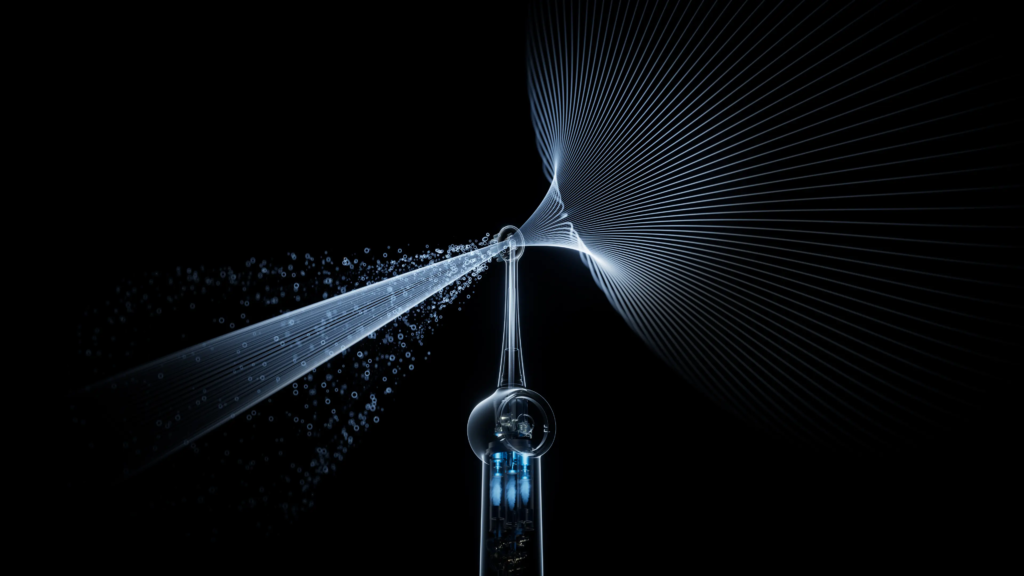
LONDON An air powered jet toothbrush turns airflow and the liquid already present during brushing into a directed microbubble stream, allowing fluid dynamics to work beside the bristles.
Step one the pump creates controlled airflow
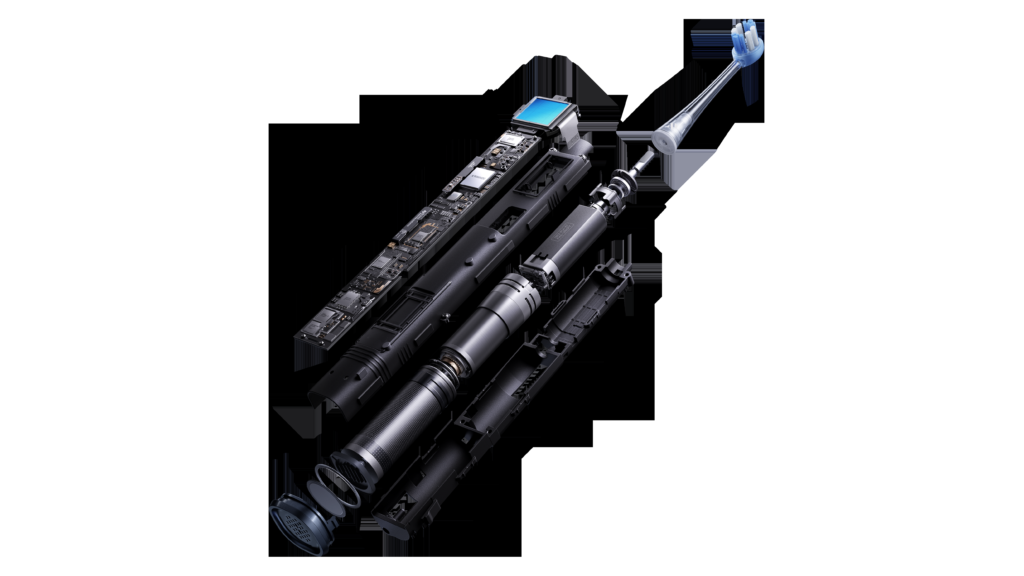
The process begins inside the handle. In the RANVOO AirJet X5, a variable speed direct current air pump creates pressurized airflow independently of the motor that moves the bristles. Separating these functions allows the product to tune mechanical brushing and fluid behavior as related but distinct systems.
The pump must be compact, quiet and efficient enough for a handheld device. It also has to maintain useful output as the brush changes angle. These packaging demands are easy to overlook, yet they determine whether air powered cleaning can fit into a handle that still feels familiar in the hand.
Step two a sealed airway carries the energy
Pressurized air travels through a dedicated internal channel and into the hollow brush head. The pathway needs reliable seals because toothpaste, water and saliva surround the outlet during use. A leak would reduce performance and could introduce residue into parts that are difficult to rinse.
This airway is the clearest structural difference from a conventional sonic toothbrush. A standard handle transfers mechanical movement to the head. An AirJet handle transfers both movement and airflow, so the head becomes a nozzle as well as a bristle carrier.
Step three the chamber makes microbubbles
Near the cleaning zone, the Boosted Bubble Chamber mixes the incoming air with toothpaste and oral fluid. Instead of producing a few large foam pockets, the system is designed to create a dense population of much smaller bubbles. The manufacturer’s published explanation describes this as AirJet 2.0 microbubble cleaning.
The distinction between ordinary foam and engineered flow is control. Brushing naturally aerates toothpaste, but the amount and direction vary with technique. A pump and chamber create a repeatable source of airflow, giving the designer a better chance to manage how the mixture moves around the head.
Step four the brush head guides the flow
The Coanda inspired head is shaped to encourage the moving fluid to follow nearby curved surfaces. Tooth contours are irregular, so a jet that simply shoots straight ahead may miss the region of interest. Guiding the flow along a surface can keep microbubbles closer to enamel and the gumline as the user moves.
This part of the system depends on geometry rather than software. Outlet size, angle, surrounding surfaces and the position of the bristles all influence the stream. The design goal is distributed coverage around the head, including narrow spaces that the bristle tufts may not fully enter.
Step five soft bristles handle accessible surfaces
Airflow does not replace surface brushing. The AirJet X5 combines its microbubble pathway with soft bristles and mode specific sonic motion. The published product page highlights 0.01 millimeter bristles and a high end rounding rate, while its modes use different frequencies, flow rates, amplitudes and oscillation angles.
This arrangement divides the work. Bristles provide controlled contact on accessible enamel, and the air driven fluid supports the area beyond the contact footprint. The approach also reduces the temptation to treat raw vibration frequency as the only measure of cleaning capability.
Step six the user completes a familiar routine
The final step is behavioral rather than mechanical. The user still applies toothpaste, places the head and brushes through each zone. The jet function operates within that gesture instead of demanding a separate countertop device. The display, timer and modes help communicate what the internal systems are doing.
Maintenance remains part of the mechanism. The head and outlets should be rinsed as directed, residue should not be allowed to dry in the wet pathway, and replacement heads should be changed on schedule. A sophisticated flow system only delivers repeatable value when its cleaning instructions are simple enough to follow.
What the mechanism teaches the wider category
Air powered microbubbles are one answer to the limits of bristle contact. CameraJet uses stored mouthrinse and optical targeting instead, proving that a jet toothbrush can solve the same coverage problem through a different control system. One design distributes flow continuously; the other selects specific gaps.
Both show why the next era of toothbrush design will be judged as a system. Pump, channel, head, bristles, controls and maintenance must work together. The useful innovation is not air by itself. It is the controlled journey that turns air into cleaning action at the tooth.

